

Introduction
Imagine a computer that solves complex problems in five minutes that would take a classical supercomputer 10,000 trillion years to solve. That’s not science fiction anymore. In 2025, quantum computing has reached a watershed moment, transitioning from theoretical promise to actual, measurable commercial reality.
For years, quantum computing lived in the realm of “someday, in the future.” Researchers would announce breakthroughs, investors would get excited, and then progress seemed to slow. But 2025 changed everything. Multiple companies achieved critical milestones simultaneously, overcoming the fundamental barrier that held quantum computing back for decades: error correction.
This year marks the beginning of the quantum computing age. Not because the technology is perfect—it’s not—but because it’s finally practical enough for real-world applications. Companies are already running problems on quantum computers that wouldn’t be feasible on traditional systems. Medical device simulations. Materials science research. Financial modeling. The applications are arriving faster than most expected.
If you work in tech, business, or science, understanding quantum computing in 2025 is no longer optional. It’s becoming essential context for where technology is heading.
What Is Quantum Computing? The Basics
Before diving into 2025’s breakthroughs, let’s establish what makes quantum computers fundamentally different from the regular computers you use every day.
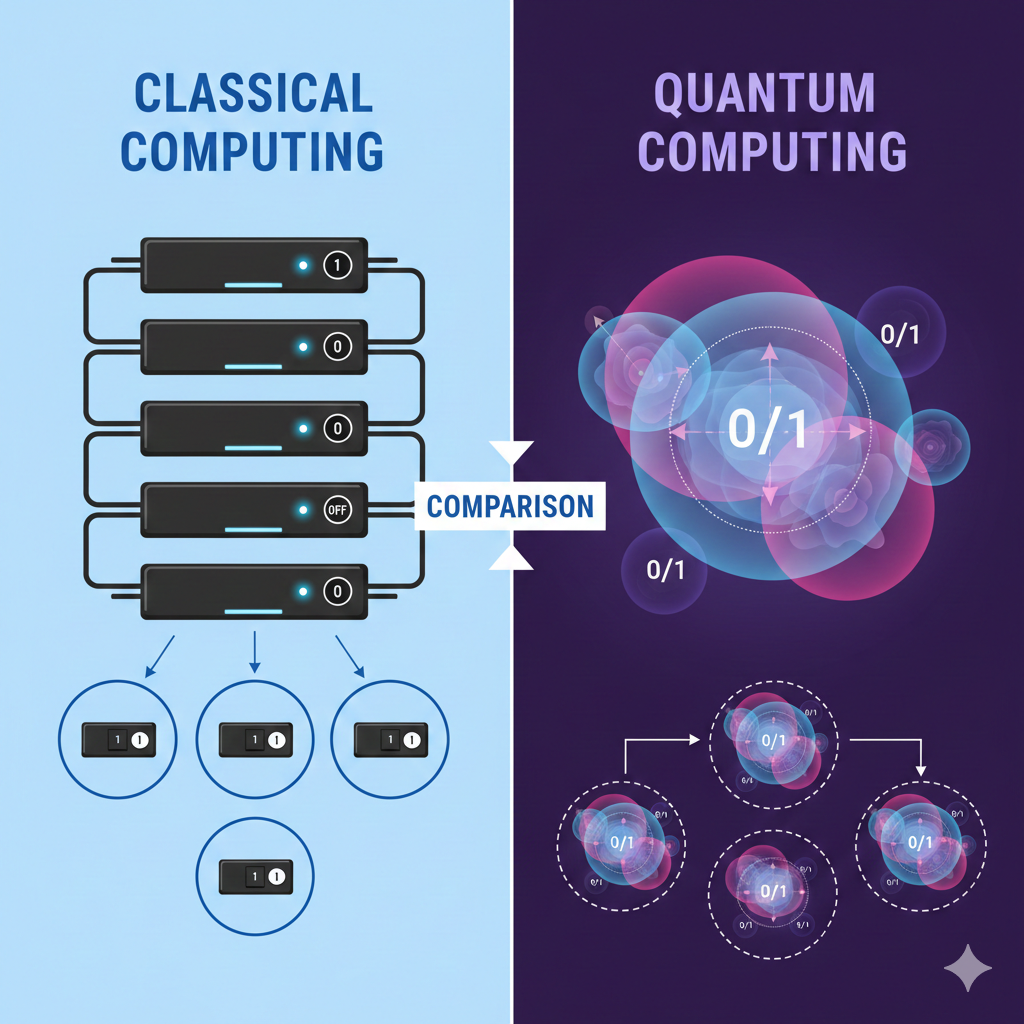
Your laptop or smartphone uses binary bits—information represented as zeros and ones. Everything your computer does boils down to manipulating millions of these ones and zeros extremely quickly. It’s like having a light switch that’s either on or off.
Quantum computers work with quantum bits, or “qubits.” Here’s where things get strange: a qubit can be zero, one, or—and this is the weird part—both simultaneously. This is called “superposition.” It’s not that we don’t know whether it’s zero or one until we measure it. It genuinely exists in both states at once, according to quantum mechanics.
This matters because it means a quantum computer can explore multiple solution paths simultaneously. If you have 100 qubits, they can explore 2^100 different possibilities in parallel. That’s about one trillion possibilities at the same time. With classical bits, you’d explore them sequentially.
There’s a second quantum property called “entanglement.” Qubits can become entangled, meaning they’re correlated in ways that have no classical equivalent. Measuring one entangled qubit instantly affects the others. This enables quantum computers to process information in fundamentally different ways than classical computers.
The challenge? Qubits are extraordinarily fragile. Tiny vibrations, temperature changes, or stray electromagnetic fields cause errors. This problem, called “decoherence,” has been the fundamental barrier to scaling quantum computers.
The Error Correction Revolution: 2025’s Game-Changing Achievement
Here’s where 2025 becomes historic. For years, quantum computing was trapped in a paradox: you need many qubits for useful computation, but more qubits meant more errors. It was like trying to build a larger building with increasingly unstable materials.
The solution was theoretical but seemingly impossible to implement: quantum error correction. The concept is elegant—use multiple physical qubits to create a single “logical qubit” that’s far more stable. It’s like creating redundancy, where even if some physical qubits fail, the logical qubit preserves its information.
The problem was that implementing error correction required so many physical qubits per logical qubit that it seemed impractical. For a useful quantum computer, you’d need millions of qubits just handling error correction, leaving very few available for actual computation.
Then came Google’s Willow chip in 2025. This wasn’t just another incremental improvement. Willow achieved something researchers called “going below threshold”—demonstrating that error rates actually decrease as more qubits are added. It’s the opposite of what happened before. More qubits used to mean more errors. Now, more qubits mean fewer errors.
Willow’s 105 superconducting qubits achieved exponential error reduction, a phenomenon that directly contradicts what previous generations of quantum computers showed. The chip completed a benchmark calculation in about five minutes that would require a classical supercomputer 10^25 years to complete. That’s a 1 followed by 25 zeros. The number is larger than the age of the universe.
This breakthrough proved that large, error-corrected quantum computers aren’t just theoretically possible—they’re achievable with current technology. That’s the fundamental shift that makes 2025 historic.
Microsoft took a different approach. Instead of using superconducting qubits, they introduced Majorana 1, a topological qubit architecture using novel superconducting materials designed to be inherently more stable. Microsoft’s approach demonstrated creating 24 entangled logical qubits—the highest number achieved by any system.
Types of Quantum Computing Approaches
The race to build practical quantum computers involves multiple technological approaches, each with advantages and tradeoffs.
Superconducting Qubits are the most mature technology and what Google’s Willow uses. Tiny circuits kept at temperatures near absolute zero become superconducting. This approach is furthest along in error correction research.
Topological Qubits, like Microsoft’s Majorana approach, use exotic physics to create inherently stable qubits requiring less error correction overhead. The theoretical advantage is remarkable—potentially needing fewer physical qubits per logical qubit—but the technology is less developed.
Trapped Ion Qubits use individual ions held in place by electromagnetic fields. Companies like IonQ champion this approach. Trapped ions have exceptional coherence times and natural gate fidelities, meaning they’re less error-prone. The challenge is scaling to thousands of qubits.
Photonic Qubits use photons (particles of light) as qubits. Advantages include operating at room temperature and compatibility with existing telecommunications infrastructure. The challenge is photonic systems haven’t yet demonstrated the same error correction progress as other approaches.
Neutral Atom Qubits use arrays of individual atoms trapped in optical tweezers. This approach offers unique scalability advantages and is gaining momentum among companies like QuEra and others.
Different approaches will likely coexist, each optimized for different applications. Superconducting might excel at general-purpose problems. Trapped ions might specialize in specific simulation problems. The quantum computing ecosystem won’t be a single winner—it’ll be multiple approaches serving different needs.
Quantum Advantage: From Theory to Reality
For years, researchers talked about “quantum supremacy” or “quantum advantage”—the theoretical point where quantum computers outperform classical computers. In 2025, we’re seeing this become real.
Google’s Quantum Echoes algorithm breakthrough demonstrated the first-ever verifiable quantum advantage running the out-of-order time correlator algorithm, which runs 13,000 times faster on Willow than on classical supercomputers. The algorithm specifically measures quantum advantage in a way that’s verifiable and useful for actual scientific computing.
But the breakthrough that captured the industry’s attention was IonQ and Ansys running a medical device simulation on a 36-qubit quantum computer that outperformed classical high-performance computing by 12 percent. This is significant because it’s not a benchmark designed to make quantum computers look good. It’s a real-world simulation—exactly the kind of problem businesses actually want to solve.
What makes these achievements significant is they’re in practical domains. Medical device simulation helps manufacturers understand equipment behavior under various conditions without expensive physical testing. When quantum computers solve these problems faster than classical systems, it’s genuinely valuable.
Real-World Applications Emerging Now
Quantum computing is shifting from “someday applications” to “we’re doing this now” applications.
Materials Science represents the nearest-term opportunity. Simulating materials at the quantum level—understanding their properties, how they’ll behave—requires quantum computation to model accurately. Classical computers struggle because atoms behave according to quantum mechanics. A quantum computer can naturally model that behavior. Research institutions have identified that quantum systems could address Department of Energy scientific workloads in materials science, quantum chemistry, and high-energy physics within five to ten years.
Pharmaceutical Development benefits from quantum simulations. Understanding protein folding, molecular interactions, and drug efficacy at a quantum level helps drug developers design better medications more efficiently. Early simulations suggest this could accelerate drug discovery timelines.
Financial Modeling represents a major commercial opportunity. Quantum computers can optimize investment portfolios, run risk simulations, and detect fraud patterns faster than classical systems. The financial industry has invested heavily in quantum computing research because the potential value is enormous.
Artificial Intelligence and Machine Learning could be transformed by quantum computing. Certain machine learning algorithms, particularly those involving optimization, could run exponentially faster on quantum systems. This is still theoretical for most use cases, but researchers are actively exploring it.
Cryptography and Security will be forever changed by quantum computing. Current encryption methods rely on it being impractical to factor large numbers. Quantum computers can factor large numbers efficiently, making current encryption vulnerable. This has triggered massive government investment in “post-quantum cryptography”—new encryption methods designed to resist quantum attacks.
The Industry Landscape: Who’s Leading
The quantum computing landscape in 2025 features major corporate players, governments, startups, and academic institutions all advancing the technology simultaneously.
Google dominates headlines with Willow, but they’re also building a broader ecosystem. They’re open-sourcing software tools and partnering with researchers to develop quantum algorithms for real problems.
Microsoft is pushing topological approaches with Majorana 1 while also building quantum software development tools and cloud access to quantum computers. Their strategy emphasizes practical business applications.
IBM continues advancing superconducting technology with their roadmap calling for increasingly larger processors. Their Kookaburra processor in 2025 features 1,386 qubits in a multi-chip configuration. They’re building a large customer base through cloud access.
IonQ champions trapped ion technology and has demonstrated the medical device simulation breakthrough. They’re focusing on specific applications where trapped ions excel.
Atom Computing, partnering with Microsoft, is developing neutral atom systems that offer unique scalability advantages.
Government Investment has reached unprecedented levels. The U.S. National Quantum Initiative, European Quantum Flagship, and Chinese government initiatives are pouring billions into quantum research. This level of investment reflects recognition that quantum computing will be transformative.
Challenges Remaining: The Honest Assessment
Despite 2025’s breakthroughs, significant challenges remain before quantum computers become as ubiquitous as classical computers.
Building Useful Logical Qubits at scale is harder than creating the architecture. We can make a few logical qubits work. Building thousands requires solving dozens of engineering challenges. Progress is rapid, but this remains genuinely difficult.
Cooling and Infrastructure costs are substantial. Most quantum computers require cooling to near absolute zero. Building facilities with this capability is expensive. Room-temperature quantum computers would be revolutionary but remain on the horizon.
Software and Algorithms are still nascent. We don’t yet have a comprehensive library of quantum algorithms for every problem. Quantum programmers need different thinking patterns than classical programmers. Developing this ecosystem takes time.
Workforce Shortage is real. You can’t find enough quantum engineers, programmers, and specialists. Educational institutions are ramping up programs, but it takes time to train new talent.
Cost and Accessibility remain barriers. Current quantum computers are expensive and available only to well-funded research institutions and corporations. For quantum computing to realize its potential, accessibility must improve.
What to Expect in 2026 and Beyond
Based on 2025’s trajectory, several developments seem likely.
More companies will claim quantum advantage in specific domains. The breakthroughs won’t be single events but a series of demonstrations across different industries and applications.
Error rates will continue declining. We’ll see logical qubit counts increase from dozens to hundreds. Physical qubit counts will continue growing.
Quantum cloud services will expand. Companies can’t all afford their own quantum computers. Cloud access will democratize quantum computing, allowing more researchers and businesses to experiment.
Quantum-classical hybrid systems will become standard. Most near-term applications won’t be purely quantum. Quantum processors will handle specific parts of computations while classical systems handle the rest.
Specialized quantum processors will emerge. Rather than general-purpose quantum computers, we’ll see systems optimized for specific problems—quantum optimization machines, quantum simulation engines, quantum AI accelerators.
Post-quantum cryptography standards will finalize. Organizations will begin transitioning to quantum-resistant encryption, a process that could take years but will be crucial.
The Bottom Line: Why 2025 Matters
Quantum computing reached an inflection point in 2025. The transition from “promising research” to “practical technology” is happening now. Error correction breakthroughs from Google and Microsoft proved that scaling quantum computers is possible. Early applications in medical device simulation and materials science show genuine value.
This doesn’t mean quantum computers will replace classical computers. Most computing tasks will continue using classical systems. But for specific, quantum-suitable problems, quantum computers will become the preferred approach.
If you’re in an industry that could benefit from quantum computing—pharmaceuticals, materials science, finance, AI—now is the time to start engaging. Understand the capabilities and limitations. Begin investigating how quantum computing could help your organization. The companies that position themselves now will have advantages as the technology matures.
The quantum computing age hasn’t arrived yet. But in 2025, it became clear that it’s on the horizon, and it’s arriving faster than many expected.


